
Ceramic Fiber Textiles
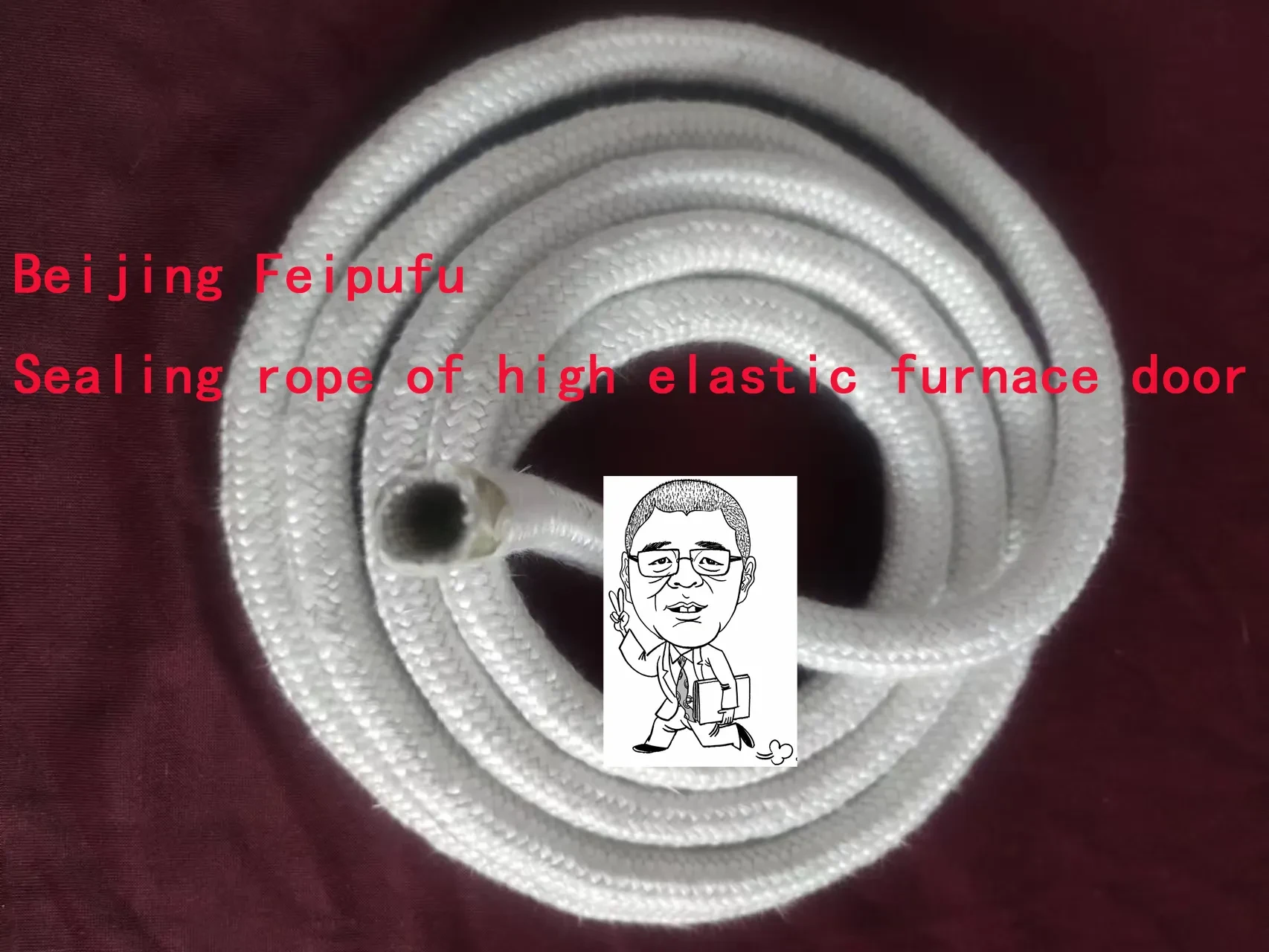
High-Elasticity Sealing Rope
Code prefix HR
High-elasticity sealing rope is built for tunnel furnaces, baking ovens and oven doors. It starts from a braided rope of glass or ceramic fiber and adds an internal spring structure that raises radial elasticity, so the rope recovers after each door closure instead of flattening permanently. The fiber layer separates the metal faces of the door, which buffers the closing action and reduces noise.
- Continuous
- 1000°C
- 1832 °F
- Short peak
- 1260°C
- 2300 °F
- Construction
- Unreinforced
- HR
Spec sheets are issued against the confirmed grade, with the test method named on the report.
01 — Product description
Product description
High-elasticity high-temperature resistant sealing rope is suitable for high-temperature door sealing on tunnel furnaces, ovens and baking ovens. It is based on a braided rope of glass fiber, ceramic fiber and other high-temperature fibers, with a special spring structure added inside to raise radial elasticity for door sealing. With the product fitted, the metal faces of the door are separated by the fiber tape, which buffers the equipment and reduces noise.
The product can be made into round, P-type (tadpole-shaped), and Ω-type (double-tail-shaped) structures, and can also be correspondingly called P-type sealing rope, high-temperature resistant sealing tadpole tape, and double-tail high-elasticity high-temperature resistant sealing rope.
Optional materials include fiberglass, ceramic fiber, soluble fiber, and basalt fiber, which can be selected and adapted according to the actual working temperature of the equipment.
Product parameters
| Item | Value |
|---|---|
| Spherical diameter | 6mm-20mm |
| Total width | Customizable |
| Applicable temperature range | 500°C~1000°C (determined by material selection) |
| Color | Natural color of the selected high-temperature resistant fiber material |
Application scope
Suitable for furnace door sealing scenarios in tunnel furnaces, ovens, baking ovens, coke ovens, chimney doors, and various boiler equipment, and can adapt to elastic sealing conditions of industrial high-temperature equipment.
Working condition suitability and restrictions
The product is suitable for dry high-temperature static sealing and conventional intermittent opening and closing sealing conditions, relying on the built-in spring for elastic compensation. The applicable temperature of the product is determined by the selected fiber material. Long-term use beyond the material's temperature resistance limit is prohibited.
The product is not suitable for conditions involving strong acid or alkali corrosion, long-term liquid immersion, continuous high-speed airflow erosion, high-pressure impact, or high-frequency continuous opening and closing friction. It is not suitable for aerospace vehicle core pressure-bearing or high-temperature critical conditions, and is only suitable for conventional industrial furnace body sealing scenarios.
Usage precautions
- Match the corresponding material and specification of sealing rope according to the actual working temperature, sealing structure, and opening and closing frequency of the equipment.
- During installation, ensure the sealing rope fits the sealing surface without deviation or extrusion deformation, ensuring sealing compensation effect.
- Regularly inspect product elasticity, wear, aging, and deformation status. In case of elastic failure or damage, replace promptly.
- Cutting and operation of fiber materials generate fiber dust. Maintain ventilation during operation and wear dust-proof protective equipment.
- All technical data are for reference only. Actual performance depends on usage conditions. Users should conduct their own suitability testing and comply with relevant safety regulations and standards.
02 — Characteristics
Spring inside the braid
The internal spring restores the section after compression, which is what a plain rope cannot do over thousands of cycles.
Radial recovery
Designed for door seals where the gap is closed and opened repeatedly, not for static joints.
Metal separation
The fiber layer keeps the door faces apart, cushioning the close and cutting the noise of metal contact.
Fiber choice
Glass for the 500 C class, ceramic where the door runs hotter and a 1000 C continuous rope is needed.
03 — Typical properties
Values typical, confirm against duty
| Test item | Value | Note |
|---|---|---|
| Construction | Radial elasticity | |
| Fiber | Sets temperature class | |
| Section shapes | Tadpole and double-tail options | |
| Spherical diameter | Round section | |
| Applicable range | Determined by material selection | |
| Materials | Selected per duty | |
| Effect | Fiber separates metal faces | |
| Duty | Tunnel furnace, oven |
04 — Standard sizes
| Product code | Dimensions |
|---|---|
| HR-R | Round section, spherical diameter 6–20 mm |
| HR-P | P-type (tadpole-shaped) section, size to order |
| HR-O | Ω-type (double-tail-shaped) section, size to order |
05 — Where it is used
- Tunnel furnace door seals
- Baking and drying ovens
- Industrial oven doors
- Repeatedly opened chambers
- Noise-sensitive door sealing
Service limits
- The spring is a steel component; confirm the maximum temperature of the spring against the door face temperature.
- Make the rope continuous around the door or join it at a corner, not mid-seal.
- Replace the rope when radial recovery drops and the door no longer seals evenly.
Related materials
View family
High-Elasticity Sealing Rope
HR