
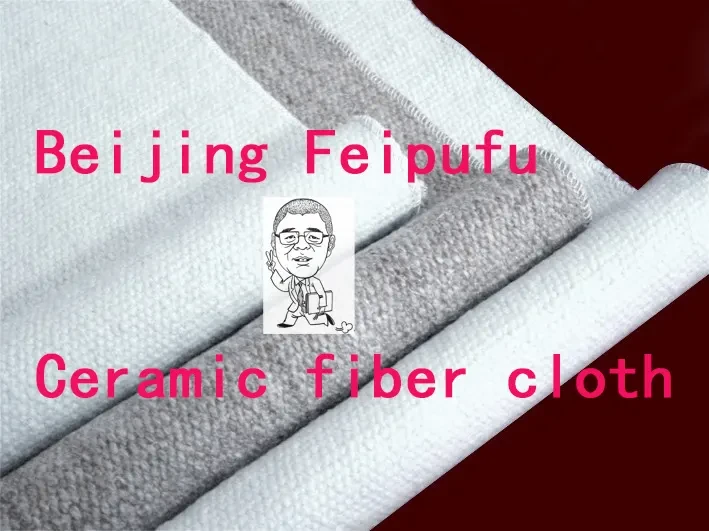
Ceramic Fiber Textiles
Ceramic Fiber Cloth
Code prefix CC
Ceramic fiber cloth, also called aluminosilicate fiber cloth, is woven from ceramic fiber yarn spun from alumina-silica staple. Glass filament reinforcement gives 650 C continuous service, stainless steel reinforcement gives 1000 C, and both take a 1260 C short excursion. The cloth resists splash from molten aluminium and zinc and can be heat cleaned to burn out the organic sizing before it goes into a clean process.
- Continuous
- 1000°C
- 1832 °F
- Short peak
- 1260°C
- 2300 °F
- Construction
- Wire reinforced
- CC
Spec sheets are issued against the confirmed grade, with the test method named on the report.
01 — Product description
Product description
Ceramic fiber cloth, also called aluminosilicate fiber cloth, is made from ceramic fiber as the main raw material through spinning and weaving. Glass fiber or heat-resistant stainless steel wire can be added as reinforcement according to the working temperature and working conditions. Glass fiber reinforced cloth has a continuous use temperature of 650°C and stainless steel wire reinforced cloth 1000°C, with a short-term tolerance temperature of up to 1260°C. The product resists splash erosion from molten aluminium and zinc, and can be sintered to remove its internal organic content.
Product parameters
| Item | Value |
|---|---|
| Color | White |
| Short-term tolerance temperature | 1260°C |
| Fiber diameter | 3~5μm |
| Aluminum oxide (Al₂O₃) | 45~48% |
| Silicon dioxide (SiO₂) | 45~55% |
| Iron(III) oxide (Fe₂O₃) | 0.7~1.2% |
| Calcium oxide, sodium chloride (CaO&NaCl) | 0.43% |
| Moisture content | |
| Organic fiber content |
Note: The above components are the composition of the ceramic fiber base material.
Product specifications
| Specification Model | Thickness (mm) | Width (mm) | Weight (g/m²) | Weave | Reinforcement Type | Continuous Working Temperature (°C) |
|---|---|---|---|---|---|---|
| CC2G | 2 | 1000 | 1000 | Plain weave | Fiberglass | 650 |
| CC3G | 3 | 1000 | 1400 | Plain weave | Fiberglass | 650 |
| CC5G | 5 | 1000 | 2300 | Twill weave | Fiberglass | 650 |
| CC6G | 6 | 1000 | 2600 | Twill weave | Fiberglass | 650 |
| CC2S | 2 | 1000 | 1100 | Plain weave | SUS304 stainless steel wire | 1000 |
| CC3S | 3 | 1000 | 1500 | Plain weave | SUS304 stainless steel wire | 1000 |
| CC5S | 5 | 1000 | 2400 | Twill weave | SUS304 stainless steel wire | 1000 |
Working condition suitability and restrictions
Different reinforcement materials of this product correspond to different use temperatures. 1260°C is only the short-term tolerance temperature; long-term over-temperature operation is prohibited. The product can only withstand short-term splashing of molten aluminum and zinc, and cannot withstand continuous erosion or immersion by molten metal.
Usage precautions
- Cutting, processing, and installation of ceramic fiber material generate fiber dust. Maintain ventilation during operation, wear dust-proof protective equipment, and dispose of waste in accordance with local environmental regulations.
- The product contains a small amount of organic fiber. Initial high-temperature use may produce carbonization and smoking, which is a normal process characteristic and does not affect product performance.
- Use temperature should be matched according to reinforcement material. Over-temperature and over-working-condition use are strictly prohibited.
- During use, regularly inspect product condition. In case of powdering, damage, shrinkage, or failure, replace promptly.
- All technical data are for reference only. Actual performance depends on usage conditions. Users should conduct their own suitability testing and comply with relevant safety regulations and standards.
02 — Characteristics
Two reinforcement classes
Glass filament holds the cloth together and keeps it dielectric; SUS304 wire carries far higher tensile load but conducts and corrodes in wet chloride service.
Plain or twill
Plain weave is firm and balanced for gaskets and wrapped pipework; twill puts more yarn on the face for covers and joints that have to drape.
Heat cleaned on request
Sintering removes the organic sizing so the cloth releases less smoke on first heat, at the cost of some flexibility at the fold line.
Molten metal splash
The fiber chemistry resists splash contact from aluminium and zinc, which is why the cloth appears on foundry curtains and die-cast guards.
03 — Typical properties
Values typical, confirm against duty
| Test item | Value | Note |
|---|---|---|
| Colour | Natural, uncoated | |
| Short excursion | Not a duty rating | |
| Fiber diameter | Spun staple | |
| Al2O3 | Base fiber chemistry | |
| SiO2 | Base fiber chemistry | |
| Fe2O3 | Base fiber chemistry | |
| CaO and NaCl | Base fiber chemistry | |
| Moisture | As delivered | |
| Organic content | Burns out on first heat |
04 — Standard sizes
| Product code | Dimensions |
|---|---|
| CC2G | 2 mm × 1000 mm, 1000 g/m², plain, glass, 650 C |
| CC3G | 3 mm × 1000 mm, 1400 g/m², plain, glass, 650 C |
| CC5G | 5 mm × 1000 mm, 2300 g/m², twill, glass, 650 C |
| CC6G | 6 mm × 1000 mm, 2600 g/m², twill, glass, 650 C |
| CC2S | 2 mm × 1000 mm, 1100 g/m², plain, SUS304, 1000 C |
| CC3S | 3 mm × 1000 mm, 1500 g/m², plain, SUS304, 1000 C |
| CC5S | 5 mm × 1000 mm, 2400 g/m², twill, SUS304, 1000 C |
05 — Where it is used
- Furnace door and flange seals
- Expansion joint covers
- Molten metal splash guards
- Base cloth for removable covers
- Cable and pipe wrap in hot zones
- Foundry ladle and tundish covers
- Heat treatment fixture and jig linings
Service limits
- 1. Cutting, processing, and installation of ceramic fiber material generate fiber dust. Maintain ventilation during operation, wear dust-proof protective equipment, and dispose of waste in accordance with local environmental regulations.
- 2. The product contains a small amount of organic fiber. Initial high-temperature use may produce carbonization and smoking, which is a normal process characteristic and does not affect product performance.
- 3. Use temperature should be matched according to reinforcement material. Over-temperature and over-working-condition use are strictly prohibited.
- 4. During use, regularly inspect product condition. In case of powdering, damage, shrinkage, or failure, replace promptly.
- 5. All technical data are for reference only. Actual performance depends on usage conditions. Users should conduct their own suitability testing and comply with relevant safety regulations and standards.
Related materials
View family
Ceramic Fiber Cloth
CC