
Soluble Fiber Textiles
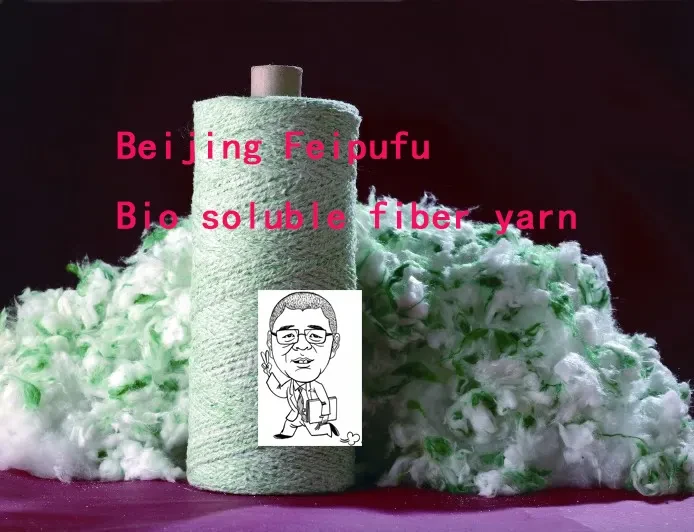
Soluble Fiber Yarn
Code prefix BY
Soluble fiber yarn is spun from bio-soluble fiber and wound on cones, with glass filament or heat-resistant alloy wire added according to the duty. Continuous service runs from 650 C to 1000 C depending on reinforcement, with a 1200 C short excursion. Tex, ply and reinforcement are specified together, because a yarn that braids well may not sew well.
- Continuous
- 1000°C
- 1832 °F
- Short peak
- 1200°C
- 2192 °F
- Construction
- Glass reinforced
- BY
Spec sheets are issued against the confirmed grade, with the test method named on the report.
01 — Product description
Tex, ply and reinforcement are one decision
AES yarn is supplied on cones with glass filament or alloy wire added at spinning or plying. Continuous service ranges from 650 C with glass reinforcement to 1000 C with wire, and the yarn takes a 1200 C short excursion. The listed counts pair the single yarn tex with the plyed total so a braiding line can be set without conversion.
Reinforcement changes more than temperature. Glass gives dielectric behaviour and a softer hand; wire gives tensile strength and conductivity. A yarn chosen for a braided seal may be the wrong choice for a sewing thread, because abrasion on the needle damages the wire and the seam then fails at the stitch.
| Code | Single tex | Plyed tex | Reinforcement |
|---|---|---|---|
| BY525G×2 | 525 | 1080 | Glass, 650 C |
| BY630G×2 | 630 | 1300 | Glass, 650 C |
| BY830G×2 | 830 | 1710 | Glass, 650 C |
| BY1000G×2 | 1000 | 2000 | Glass, 650 C |
| BY2000G×1 | 2000 | 2000 | Glass, 650 C |
Handling
- Store cones dry and sealed; sizing picks up moisture.
- Confirm twist direction and ply before setting up the machine.
- Separate sewing yarn from braiding yarn in the specification.
- Apply dust controls when the yarn is abraded or cut.
02 — Characteristics
Reinforced plies
Glass filament for 650 C, alloy wire for 1000 C service.
Converter ready
Supplied on cones for braiding, weaving and heavy sewing.
Documented tex
Single and plyed counts are listed so the downstream process can be set directly.
03 — Typical properties
Values typical, confirm against duty
| Test item | Value | Note |
|---|---|---|
| Fiber | EU 67/548 NOTA Q | |
| Continuous | By reinforcement | |
| Short excursion | Not a duty rating | |
| Fiber diameter | Spun staple | |
| Moisture | As delivered | |
| Organic content | Burns out on first heat |
04 — Standard sizes
| Product code | Dimensions |
|---|---|
| BY525G×2 | 525 tex single, 1080 tex plyed, 2 strand, glass, 650 C |
| BY630G×2 | 630 tex single, 1300 tex plyed, 2 strand, glass, 650 C |
| BY830G×2 | 830 tex single, 1710 tex plyed, 2 strand, glass, 650 C |
| BY1000G×2 | 1000 tex single, 2000 tex plyed, 2 strand, glass, 650 C |
| BY2000G×1 | 2000 tex single, 1 strand, glass, 650 C |
05 — Where it is used
- Braided rope and packing
- Woven tape and cloth
- Sewing seams in covers
- Expansion joint braid
- Transport thermal barriers
Service limits
- Reinforcement changes both temperature class and dielectric behaviour.
- Store dry and sealed to protect the sizing.
- Dust controls apply when the yarn is abraded.
Related materials
View family
Soluble Fiber Yarn
BY